AI in Global Flight Operations: Shaping the Future of Aviation
Introduction
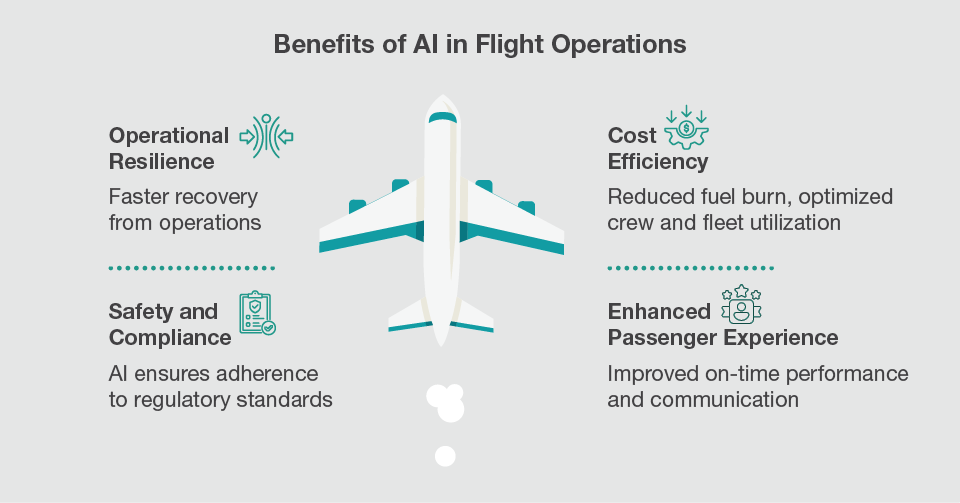
Artificial Intelligence (AI) is redefining the aviation industry, particularly in-flight operations, where complexity and unpredictability are the norm. Airlines face challenges such as weather disruptions, air traffic congestion, and resource constraints, which collectively cost the industry billions annually. To address these issues, most airlines are actively experimenting with AI and Machine Learning (ML) solutions across their operational ecosystems. These initiatives aim to extract maximum value from predictive analytics, real-time optimization, and automation. Rather than relying on reactive problem-solving, AI enables a shift toward predictive and prescriptive decision-making, helping airlines achieve operational resilience, cost efficiency, and superior passenger experience.
Current Trends:
-
The global AI in aviation market is projected to grow from $1.76 billion in 2025 to $4.86 billion by 2030, at a CAGR of 22.6%.
-
82% of airline executives consider AI essential for future growth, and 74% of new airline projects already incorporate AI technology at the planning stage.
-
AI-powered predictive maintenance can reduce aircraft maintenance costs by up to 30%, while AI-driven flight scheduling systems have improved on-time departure rates by 12%.
-
AI-based route optimization is cutting fuel consumption by 10–12%, contributing to sustainability goals and cost savings.
These figures underscore a clear trend: AI is no longer experimental—it is becoming mission-critical for flight operations worldwide.
Current Industry Trend
Most airlines are experimenting with AI/ML in their operational solutions to maximize efficiency and resilience. These pilots often start with predictive delay management and crew optimization, gradually expanding to end-to-end disruption recovery. The goal is clear: move from reactive firefighting to proactive, automated decision-making.
Industry Landscape: AI/ML Adoption in Flight Operations
AI and Machine Learning are no longer theoretical in aviation—they are actively shaping flight operations worldwide. Most airlines are experimenting with AI/ML solutions to optimize resources, predict disruptions, and enhance passenger experience. Here are some notable examples:
The Role of AI in Flight Operations
Flight operations are the backbone of airline performance, encompassing flight planning, crew scheduling, aircraft turnaround, and irregular operations (IROPS) management. These processes are highly interdependent and sensitive to disruptions caused by weather, air traffic congestion, and resource constraints.
Traditional systems rely on static rules and manual interventions, which often fail under dynamic conditions. For example, a sudden storm can trigger cascading delays across multiple flights, requiring rapid crew re-assignments and gate changes—tasks that manual systems struggle to handle efficiently.
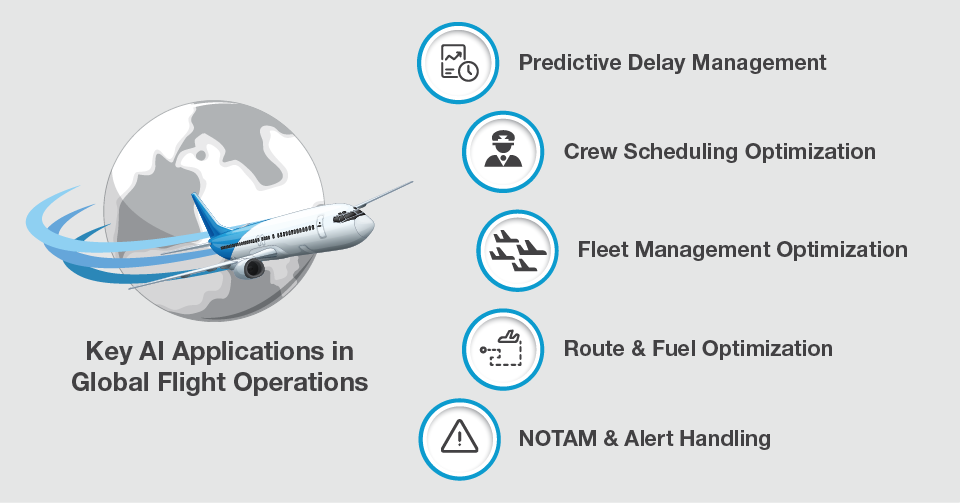
AI addresses these gaps by introducing data-driven intelligence and automation across the operational chain:
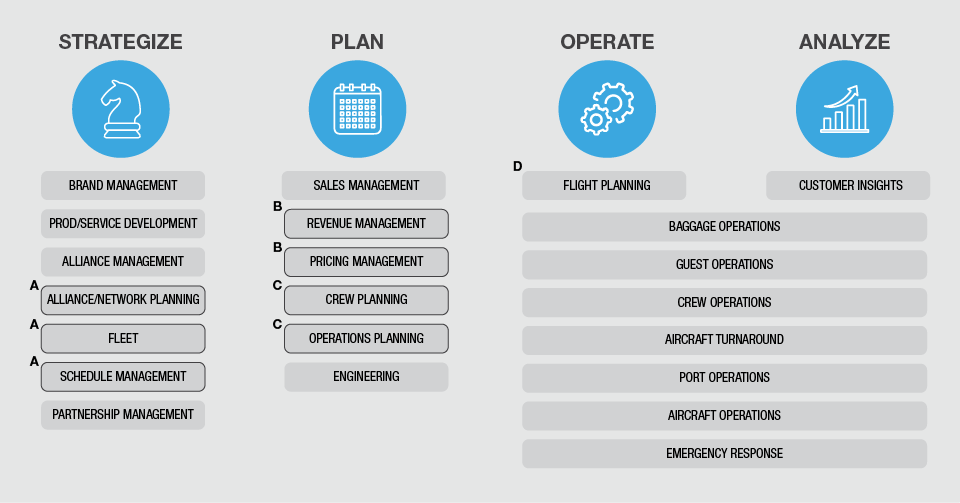
A) Prediction: AI enables tactical and operational business decisions in airline operations to be mapped out with accurate prediction of outcomes and impacts. It can predict flight delays based on weather conditions, air traffic, and maintenance status, while also anticipating airport slot conflicts and optimizing crew pairing.
B) Correlations of data: With the abundance of operational data, the challenge lies in extracting actionable insights without excessive manual effort. AI can process unstructured data and uncover correlations between seemingly unrelated factors. For example, it can link passenger load factors with fuel efficiency and turnaround delays, identify patterns between maintenance events and aircraft utilization, and connect weather conditions with historical delay clusters for predictive planning.
C) Agile and adaptable: Even the most well-planned operations face unexpected disruptions such as technical issues, weather changes, or ATC restrictions. AI makes operations agile by enabling rapid re-planning when disruptions occur. It uses historical and real-time data to re-optimize rotations, adjust fleet assignments dynamically, and fine-tune ground handling tasks.
D) Machine learning: AI machine learning techniques allow systems to learn from past operational data and continuously improve. By adjusting algorithms based on historical experiences, ML enhances delay prediction accuracy, detects anomalies in rotation planning, and recommends better recovery strategies. Over time, these models become smarter, enabling airlines to optimize fuel consumption, improve on-time performance, and reduce operational risks through predictive insights.
Implementation Roadmap
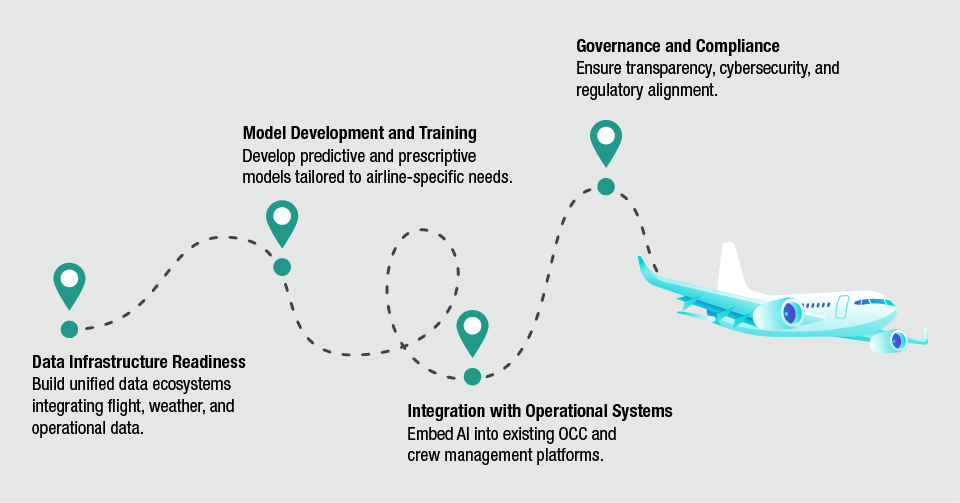
To successfully deploy AI in flight operations, airlines should follow a structured approach:
Challenges and Mitigation
-
Data Silos: Legacy systems hinder interoperability.
Solution: API-driven integration and cloud-based data lakes.
-
Cybersecurity Risks: Increased attack surfaces.
Solution: Multi-layered security and continuous monitoring.
-
Workforce Adaptation: Cultural shift to AI-driven processes.
Solution: Upskilling and collaborative AI-human workflows.
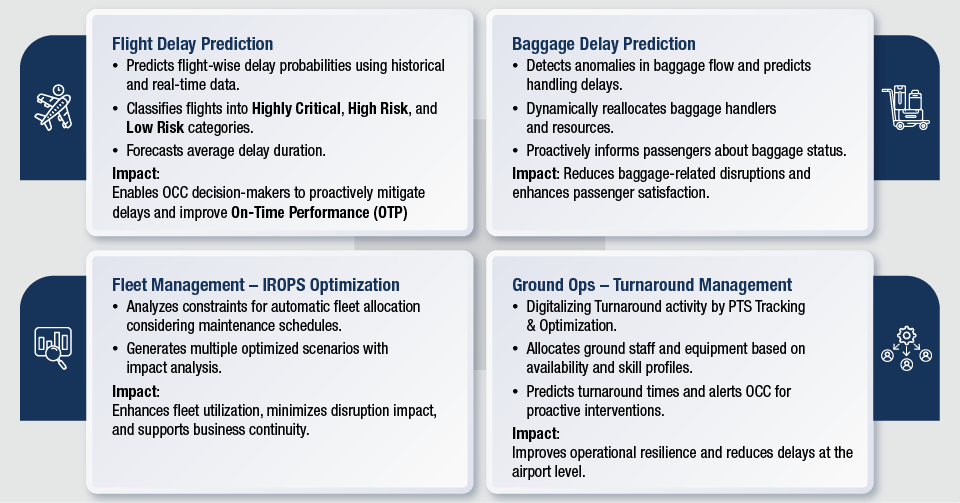
Our PoCs: AI/ML in Action
Future Outlook: From AI to Agentic AI
While AI today focuses on prediction and optimization, the next frontier is Agentic AI—autonomous systems capable of executing decisions across multiple operational domains. Future advancements will include:
-
Integration with Digital Twins for real-time simulation of airport ecosystems.
-
Quantum Computing Synergy for complex optimization tasks like crew pairing.
-
Sustainability Impact through AI-driven fuel and route optimization.
Conclusion
AI is no longer a futuristic concept—it is a strategic enabler for global flight operations. By embracing AI-driven solutions, airlines can achieve resilience, efficiency, and sustainability. As the industry evolves, Agentic AI will take these capabilities further, enabling autonomous, adaptive systems that transform aviation into a truly intelligent ecosystem.