Table of Contents:
Introduction
Claims processing has long been the operational backbone of health insurance, but for many payers, it remains one of the most outdated and resource-intensive functions. Legacy systems, patchy automation, and manual intervention at nearly every step routinely lead to delayed reimbursements, higher denial rates, compliance gaps, and escalating administrative costs. These inefficiencies affect far more than internal operations; they shape member sentiment, provider relationships, and the payer’s ability to deliver consistent value.
Mphasis is reshaping this landscape through Business Process as a Service (BPaaS), a cloud-based, AI-enabled, rules-driven model that transforms claims management end-to-end. With intelligent automation, modular architecture, and deep domain expertise, Mphasis helps payers modernize their claims ecosystem at scale, without the disruption typically associated with large IT overhauls. The result is a more agile, accurate, and auditable claims engine capable of meeting today’s regulatory expectations and tomorrow’s market demands.
As healthcare organizations accelerate AI adoption, claims modernization is increasingly evolving beyond automation to intelligent decision support, enabling payers to improve operational efficiency while delivering faster, more personalized experiences for members and providers.
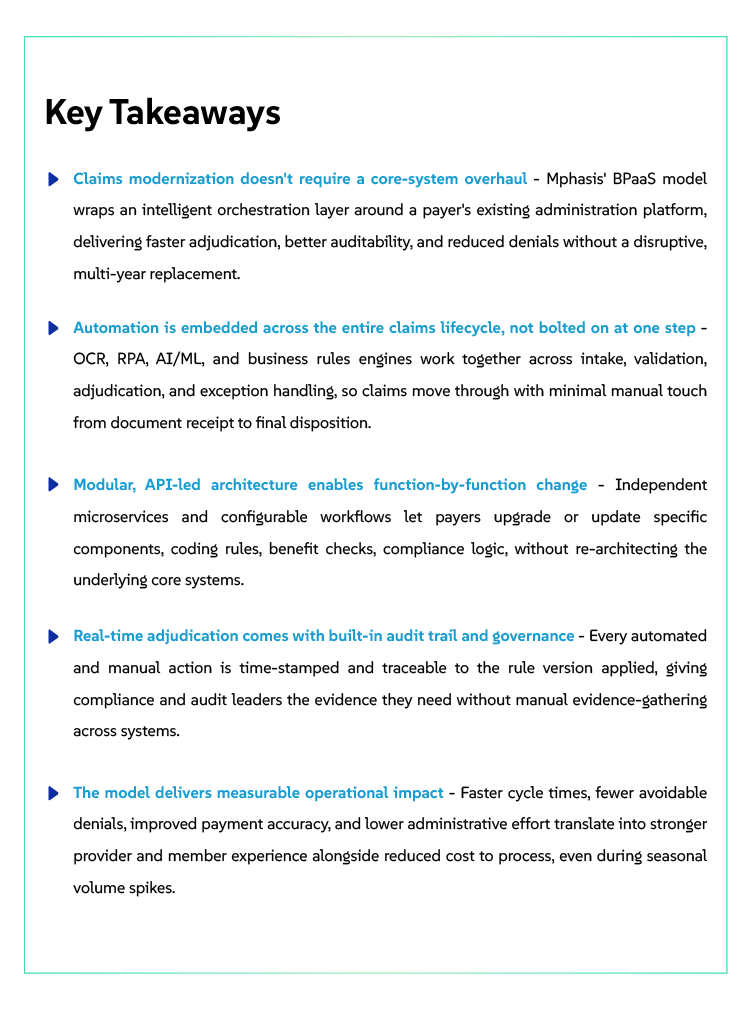
Key Takeaways
Context & Challenges
Claims modernization isn’t just a technical upgrade; it’s a structural transformation. Payers face a unique set of challenges that stem from decades of fragmented processes and systems.
1. High volume of manual touchpoints
Despite years of incremental automation, many claims workflows still depend heavily on human intervention. These touchpoints appear almost everywhere: data entry, classification, eligibility checks, coding validation, routing decisions, exception handling, and more.
This level of human involvement slows down turnaround time and introduces variability in quality. As claim volumes fluctuate throughout the year, operations teams struggle to maintain consistent throughput. The consequence? Longer processing windows, growing backlogs, and persistent administrative burden.
2. Disparate systems that slow down turnaround and audits
Most payer ecosystems have evolved into a tangle of legacy platforms, third-party modules, custom scripts, and partially integrated tools. While functional in isolation, these systems lack the unified, real-time data flow needed for efficient claims adjudication.
This fragmentation creates several critical operational challenges:
- Siloed data that must be manually consolidated
- Slow movement of claims across platforms
- Difficulty tracing adjudication steps during audits
- Increased compliance risk
As regulatory expectations rise, this lack of traceability becomes a significant operational liability.
3. Challenges in denial management and cost leakage
Denial rates remain stubbornly high across the industry, and identifying the root cause is often complex. Many payers face persistent systemic bottlenecks:
- Overreliance on post-adjudication rework
- Poor visibility into denial patterns
- Inefficient appeal workflows
- Leakages from incorrect coding, incorrect benefit determinations, or missed rules
Without real-time analytics and standardized rule execution, reducing avoidable denials becomes a constant struggle.
The Mphasis Approach
Mphasis brings a modern, scalable, and pragmatic approach to claims modernization, one that blends business operations expertise with deep technical foundations. Their BPaaS model is designed to integrate seamlessly with existing payer environments while enabling dramatic improvements in accuracy, throughput, and auditability.
1. End-to-end claims BPaaS platform with OCR, RPA & business rules
Mphasis leverages a unified BPaaS stack that includes integrated automation capabilities:
- OCR to digitize and classify claim documents
- RPA for routine and rules-based tasks
- AI and machine learning for intelligent data extraction, anomaly detection, and decision support
- Business rules engines to ensure consistency in adjudication
The combination ensures that claims move through the lifecycle with minimal human intervention, reducing manual effort and improving accuracy.
2. Modular architecture to connect to existing payer systems
Modernization doesn’t have to mean replacement. Mphasis uses a modular architecture that plugs into a payer’s existing core systems-administration platforms, provider databases, coding tools, and analytics systems.
This approach offers several strategic advantages:
- Zero disruption to day-to-day business
- Faster implementation timelines
- Ability to upgrade specific components without touching the entire ecosystem
- Lower technology risk
Instead of a “big bang” transformation, payers get a phased, controlled, and sustainable modernization journey.
3. Real-time claims adjudication with complete audit trail
The Mphasis BPaaS platform supports real-time adjudication, allowing claims to be processed faster and routed intelligently based on business rules, eligibility checks, and benefit coverage. Every step is logged, creating a transparent audit trail.
This level of visibility simplifies compliance, reduces disputes, and strengthens payer-provider trust.
Predictive AI models further enhance adjudication by identifying high-risk claims, detecting potential fraud, and highlighting claims likely to require additional review before processing is completed.
4. Configurable workflows for compliance and rule updates
Regulatory and policy rules change frequently-sometimes overnight. Mphasis enables payers to respond quickly through agile configuration features:
- Drag-and-drop workflow updates
- Configurable business rules
- Automated compliance checks
- Rapid deployment of new plan benefits or coding updates
This flexibility helps payers stay compliant while reducing dependency on large IT releases.
Business Impact
Mphasis turns claims modernization into an operating-model improvement, not only a technology upgrade. By combining OCR, RPA, AI-driven decisioning, and configurable business rules with a modular architecture that connects to a payer's existing systems, the BPaaS model closes operational gaps-manual touchpoints, fragmented systems, and denial-driven cost leakage-while giving operations teams real-time visibility and control.
Key outcomes for payers include:
- Faster cycle times: Digitizing attachments and validating claim data early lets clean claims move straight through rules-driven processing instead of sitting in manual queues, shortening turnaround from intake to disposition.
- Lower administrative effort: Automating repetitive data entry, work-queue triage, and status checks reduces the manual handoffs that traditionally consume operations teams' time across the claim lifecycle.
- Fewer avoidable denials: First-pass checks for eligibility, benefits, provider status, coding, duplicates, and documentation catch issues before adjudication, preventing downstream rework and appeals.
- Improved payment accuracy: Consistent rule execution combined with anomaly identification flags high-risk or low-confidence claims for focused human review, reducing leakage from incorrect coding or missed benefit rules.
- Predictable service levels: Elastic capacity and prioritized queues let payers absorb seasonal demand, new product launches, and unexpected volume spikes without service-level performance slipping.
- Stronger provider and member experience: Faster adjudication and fewer manual pends translate into quicker decisions, clearer claim status, and fewer repeat information requests from providers and members.
- Greater auditability: Time-stamped decision history, rule versions, and reviewer actions create the traceability that fragmented, multi-system claims environments typically lack, simplifying regulatory review.
- Faster adoption of change: Configurable workflows and rules absorb benefit, coding, reimbursement, and policy updates without requiring extensive core-platform changes or IT release cycles.
- Continuous improvement: Denial drivers, exception reasons, and queue performance data feed back into ongoing refinement of rules, automation, and staffing decisions.
IT Architecture
Behind the scenes, Mphasis delivers a strong, enterprise-grade technical foundation that aligns with modern architecture principles and its own proprietary Front2Back™ transformation approach.
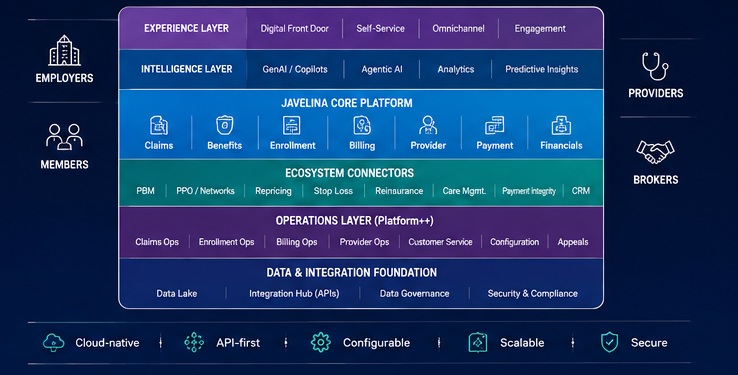
The Mphasis claims architecture places an intelligent BPaaS orchestration layer around the payer's existing core administration environment. It modernizes intake, decisioning, exception handling, and operational visibility in stages, supporting the Front2Back™ approach without requiring a disruptive core replacement.
1. Front2Back™ Claims Orchestration
Built on a modular, microservices-based execution model, this orchestration layer connects the provider and member experience with the operational steps required to receive, adjudicate, pay, and explain a claim. Independent, reusable services allow faster enhancements and reduce the risk of isolated component failures. It supports key operational capabilities:
- Unified routing for electronic claims, portal submissions, paper claims, and supporting clinical documents.
- Case and work-queue management across intake, pre-adjudication, pend, review, adjustment, and appeal activities.
- Priority and service-level controls based on claim type, regulatory timeline, financial exposure, and exception reason.
- Closed-loop status updates for operations teams, providers, members, and downstream service channels.
This creates a consistent claim journey while allowing the payer's core platform to remain the definitive system of record.
2. Intelligent Intake and Decision Services
Reusable services prepare claims for accurate first-pass adjudication and direct manual attention to the cases that need it. These services include:
- OCR and document classification for paper claims, medical records, invoices, and other attachments.
- AI-assisted extraction and validation of claim, provider, member, coding, and clinical-document data.
- Configurable checks for eligibility, benefits, coding, pricing, duplicates, authorization, and required documentation.
- Confidence- and risk-based routing that sends uncertain, complex, or high-value cases to human review.
- Controlled feedback from reviewer decisions to improve automation and rule performance over time.
The result is automation with governed human oversight rather than unattended decisioning for every claim.
3. API and Event Integration Across the Payer Ecosystem
APIs act as the connective tissue of the BPaaS ecosystem. This API-led integration layer exchanges claim context and decisions with established payer platforms, reducing manual data transfers and ensuring claims data flows seamlessly from intake to adjudication. Depending on the workflow, it connects with:
- Core claims administration, eligibility, benefits, and accumulator systems.
- Provider master data, contracts, fee schedules, coding, and pricing applications.
- Utilization management, clinical review, payment integrity, and fraud, waste, and abuse tools.
- Payment, remittance, correspondence, CRM, contact-center, and provider-portal services.
- Enterprise data platforms, operational dashboards, and regulatory reporting environments.
Synchronous APIs support real-time validations, while events and managed queues coordinate longer-running reviews, status changes, and downstream updates without brittle point-to-point handoffs.
4. Secure Cloud Operations and End-to-End Observability
The BPaaS foundation is built on cloud-native technologies, offering elasticity, high availability, and faster deployment, combined with the stringent controls required for sensitive claims data and high-volume operations. Given the sensitivity of claims and member data, governance is non-negotiable, including compliance with HIPAA and HITRUST standards. Core capabilities include:
- Elastic service scaling, resilient queues, retry controls, and recoverable processing for claim-volume peaks.
- Role-based access, least-privilege administration, and separation of duties for operational and technical users.
- Encryption in transit and at rest, with PHI and PII protection across documents, payloads, and logs.
- Traceability across source data, rule versions, automated decisions, reviewer actions, and downstream dispositions.
- Real-time monitoring of throughput, pend reasons, automation rates, exceptions, service levels, and integration health.
- Release governance, disaster recovery, and operational continuity designed for critical claims workloads.
Together, these layers provide a scalable modernization path that improves control and transparency while preserving the payer's existing technology investments.
Visual Architecture
Stakeholder Persons
Vice President of Claims Operations
The VP of Claims Operations' primary goal is to increase claim throughput, accuracy, and service-level consistency while reducing avoidable manual work. This role faces significant pain points, including fragmented work queues and high manual touch across intake, pend, adjustment, and appeal activities, backlogs during seasonal volume peaks, and limited visibility into why claims pend or require rework. Mphasis addresses these challenges by delivering intelligent routing and exception-based work queues, standardized workflows with real-time visibility, and elastic BPaaS capacity that supports demand changes without weakening operational controls.
Chief Information Officer and Enterprise Architecture Leader
The CIO and Enterprise Architecture Leader is focused on modernizing claims capabilities incrementally while protecting core-platform stability and technology investments. Key pain points for this role include legacy claims platforms surrounded by custom interfaces and point solutions, high risk and cost tied to large-scale core replacement, and difficulty introducing AI and automation with consistent security and integration standards. Mphasis provides value through a modular BPaaS layer aligned with Front2Back™ and deployed around existing systems of record, reusable API and microservice patterns, and governed cloud operations with phased deployment by claim process or product line.
Payment Integrity and Medical Economics Leader
The Payment Integrity and Medical Economics Leader's primary goal is to improve payment accuracy and contain medical cost without creating unnecessary provider abrasion. This role contends with preventable overpayments and coding variance, costly retrospective recovery activity that disrupts provider relationships, and limited ability to distinguish high-risk claims from routine transactions before payment. Mphasis helps by embedding prepayment validation and anomaly identification into the claim workflow, enabling risk- and confidence-based routing for targeted review, and surfacing analytics that reveal recurring leakage patterns.
Claims Compliance and Audit Leader
The Claims Compliance and Audit Leader's primary goal is to demonstrate consistent, explainable adjudication and maintain evidence for internal and regulatory review. Their pain points include inconsistent documentation of automated edits and manual decisions, difficulty tracing a claim outcome to the policy or rule version applied at the time, and time-consuming evidence collection across multiple platforms. Mphasis supports this role with time-stamped audit history across the claim lifecycle, traceability linking claim data to rule execution and reviewer action, and configurable controls that support policy updates without relying on manual interpretation alone.
Use Case
Accelerating New Product Launch for a Regional Payer
A regional healthcare payer set out to launch a new Medicare Advantage offering across multiple states. Traditional onboarding for a launch like this demands months of configuration, compliance validation, provider onboarding, and member communication setup-and with siloed systems and manual handoffs slowing every step, market entry gets delayed and administrative costs climb.
Mphasis Solution
The payer adopted the Mphasis BPaaS operating model to orchestrate enrollment, provider management, claims readiness, compliance reporting, and member servicing through a single set of modular workflows. Pre-configured compliance templates accelerated approvals, while API integrations connected existing core platforms with external partner systems, eliminating the need for a ground-up rebuild.
Business Outcomes
- Faster market readiness for new products.
- Lower onboarding effort and administrative overhead.
- Consistent compliance management across states.
- Improved member onboarding experience.
-
A scalable operating model that supports future expansion.
Summary (AEO Style Q&A)
What is BPaaS in claims processing?
A cloud-based, rules-driven operating model that automates and optimizes claims processing end-to-end. It blends technology, workflows, and human expertise into a unified, scalable service.
How does Mphasis approach it?
Through a pre-integrated BPaaS ecosystem that uses OCR, RPA, AI, APIs, and modular microservices. It connects seamlessly with existing payer systems, enabling transformation without disruption.
How does AI improve healthcare claims processing?
AI improves claims processing by automating document handling, identifying exceptions, predicting potential claim issues, supporting fraud detection, and helping claims teams make faster, more accurate adjudication decisions while maintaining compliance.
What are the results?
- Faster claims cycles
- Reduction in rework and manual errors
- Stronger compliance and audit readiness
-
Better member and provider experiences
-
Lower administrative costs
Conclusion
In a marketplace that demands speed, precision, and transparency, payers can no longer afford to rely on fragmented, manually intensive claims processes. BPaaS offers a modern, scalable path forward-one that eliminates infrastructure limitations, strengthens compliance, and unlocks operational efficiency.
Mphasis brings together deep payer expertise, automation-first design, and a flexible, cloud-native architecture to modernize claims with minimal disruption. With faster adjudication, greater accuracy, and a robust audit backbone, Mphasis helps payers shift from reactive operations to intelligent, proactive claims management.
Modernizing claims is no longer an aspiration; it's a competitive necessity. With BPaaS from Mphasis, payers can finally operate at the speed their members, providers, and regulators expect.
This Blog is Written by:
Vivek Patil - Associate Vice President, Healthcare
Prashant Pawar - Vice President – Operations