Table of Contents:
In software architecture, we speak of "Software Gravity", the conceptual force that pulls more features, complexity, and technical debt toward a system until it becomes the immovable center of every developer's universe. On November 18, 2025, Google released a platform named, pointedly, Antigravity, a direct challenge to the gravitational pull of traditional software development. Backed by a $2.4 billion investment and built from the team behind Windsurf, it was announced alongside Gemini 3 and represents something more than a new IDE. It represents a new operating model for engineering itself.
To the uninitiated, Antigravity looks like a fast code editor with an AI chatbot bolted to the side. To the practitioner who understands agentic architecture it is something far more interesting: a sophisticated orchestration engine that manages a digital workforce one that can plan, execute, verify, and document entire engineering workflows while the human engineer operates at a fundamentally higher level of abstraction.
The tools of yesterday helped you write code faster. The tools of tomorrow, need to help you orchestrate it better.", Google, November 2025
Defining the Agentic Shift
Before exploring the platform, it helps to understand what the 'Agentic Shift' actually means, and why it matters beyond marketing language.
Traditional AI coding tools were fundamentally reactive. You typed; the system suggested. You selected; the system completed. The developer remained the direct unit of production, the bottleneck between intent and output.
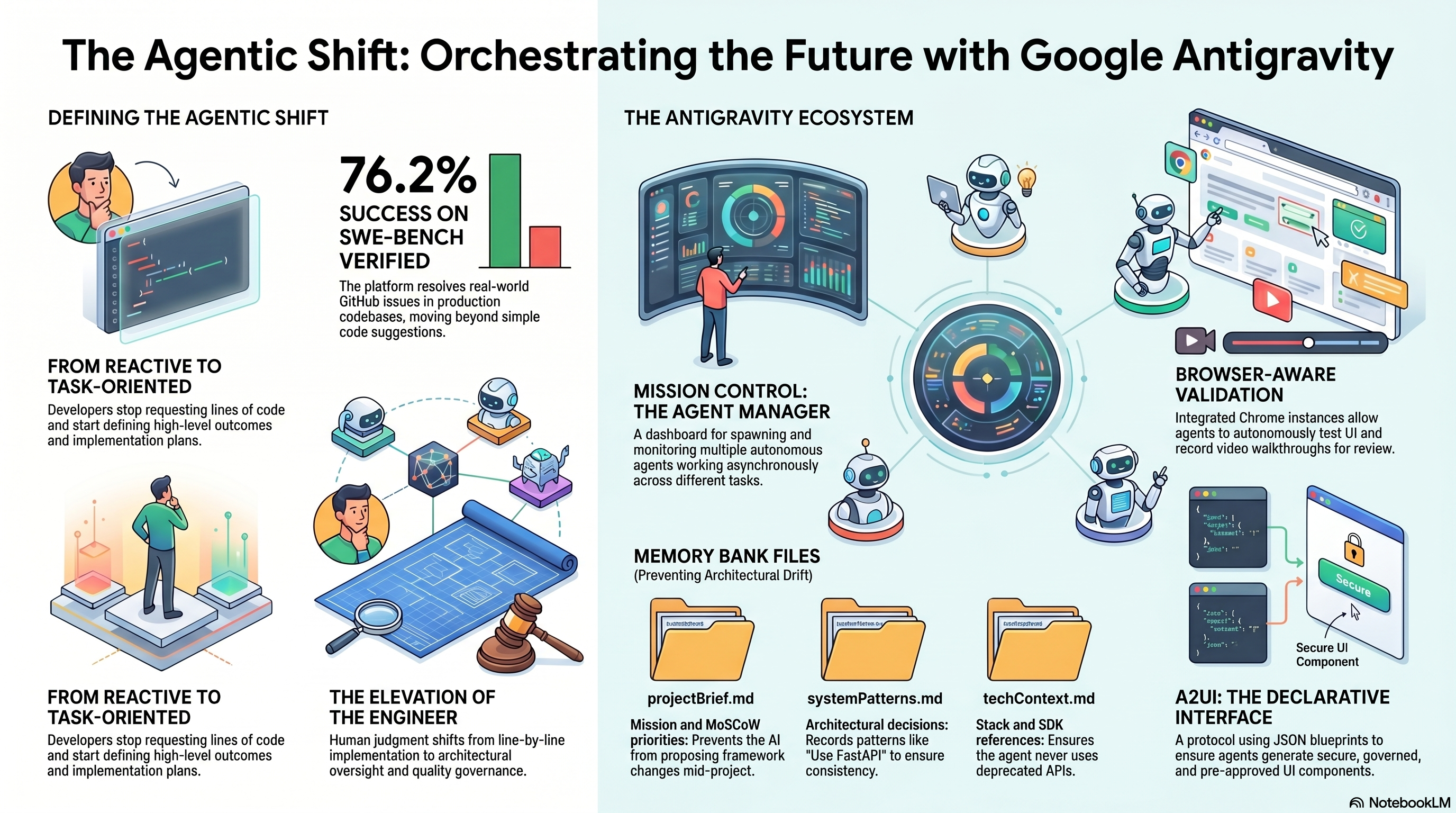
The agentic model moves that boundary. Instead of requesting the next line, the engineer defines the next outcome: create the implementation plan, wire the API, review the diff, validate the flow in a browser, and summarize what changed. The important shift is not 'AI writes code.' The important shift is that the workflow becomes task-oriented.
Antigravity achieves a benchmark score of 76.2% on SWE-bench Verified, a rigorous test measuring whether an AI can actually resolve real GitHub issues in production codebases, not contrived problems. That number matters because it signals a transition from AI as autocomplete to AI as a capable engineering collaborator.
The Architecture: Two Surfaces, One Platform
Antigravity is built on a heavily modified fork of Visual Studio Code. The foundation is familiar; what sits on top of it is not.
The Editor View
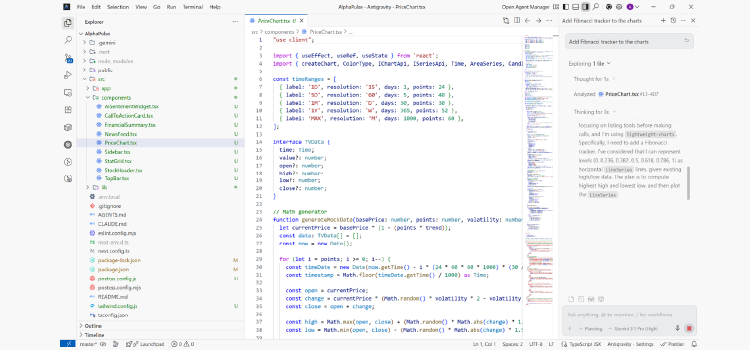
When you need to work hands-on, the Editor View provides a state-of-the-art AI-powered IDE with tab completions and inline commands, the synchronous workflow engineers already know. This is the individual contribution surface: you and the AI typing together.
The Agent Manager (Mission Control)
This is where Antigravity separates itself from every other tool in the market. The Agent Manager is not a chat window, it is a Mission Control dashboard for spawning, monitoring, and interacting with multiple autonomous agents working asynchronously across different workspaces and tasks simultaneously.
In this view, the developer acts as an architect and mission operator. You define high-level objectives, 'Migrate this database to PostgreSQL,' 'Add OAuth to the login flow,' 'Build the full AlphaPulse dashboard', and dedicated agent instances take those directives and execute them independently, reporting back with structured artifacts.
This async-first design solves something real. Chat-based tools trap engineers in modal conversation: type a message, wait for output, type the next message. Antigravity lets agents work through 30-minute tasks while the engineer reviews other work, then decides whether to accept, modify, or restart, restructuring what a developer's actual workday looks like.
Five Capabilities That Define the Platform
For teams evaluating Antigravity seriously, beyond launch-week enthusiasm, five capabilities that matter the most in the context of enterprise AI solutions.
i) Artifacts: Making Work Inspectable
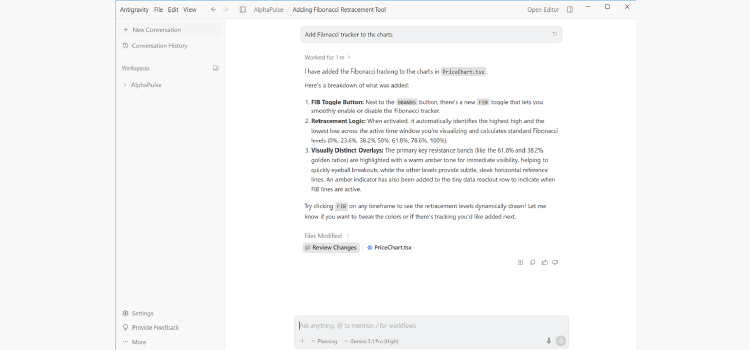
Every agent action produces verifiable deliverables: task lists, implementation plans, screenshots, browser recordings, and walkthrough documents. This artifact-based transparency is the mechanism that builds trust. Engineers can review exactly what changed, what assumptions were made, and what the agent is about to do before approving it.
ii) Browser-Aware Validation
Antigravity includes an integrated Chrome instance that agents can navigate and test autonomously. The agent can write the feature, launch the app in a terminal, open it in the browser, click through the UI, record a webp walkthrough video, and return a verified result, all within a single workflow context. This collapses the gap between 'generated output' and 'usable software.
iii) Skills: The Reusable Capability Layer
Antigravity includes an integrated Chrome instance that agents can navigate and test Skills allow teams to package reusable logic into named, loadable capabilities, a SKILL.md file that the agent reads only when that specific capability is relevant, conserving token budget through what the platform calls Progressive Disclosure. A finance-data-fetcher skill might specify exactly how to call Yahoo Finance for OHLC data and cross-reference with Finnhub headlines, ready to be invoked on any relevant project.
iv) Rules, Workflows, and the Knowledge Engine
As projects grow, the core challenge shifts from generation to drift, the tendency for an AI to forget architectural decisions as the codebase and conversation history expand. Antigravity addresses this through a structured Memory Bank: Markdown files in a .agents/ directory that serve as the project's long-term, persistent memory. Four core truth files keep the agent aligned:
Certifications and Accreditation
| File | Purpose | Key Benefit |
|---|
| projectbrief.md | Mission definition and MoSCoW-prioritized requirements | Stops the AI from proposing a new framework mid-project |
| systemPatterns.md | Records architectural decisions (e.g., 'Use FastAPI') | Privacy Information Management System (PIMS), extension to ISO 27001 |
| techContext.md | Stack versions, environment variables, SDK references | Ensures the agent never uses deprecated APIs |
| activeContext.md | Current session focus and micro-decisions | Updated after every task; maintains continuity |
v) Multi-Model Flexibility
Unlike tools locked to a single model, Antigravity ships with Gemini 3.1 Pro as the default but supports Claude Opus 4.6, Claude Sonnet 4.6, and GPT-OSS 120B within the same session. Engineers can switch models per-task, Gemini 3.1 Pro for heavy multi-step reasoning, Claude for architecture planning, without platform switching or context loss.
Native Platform vs. Team Conventions
One of the most important distinctions when evaluating Antigravity is separating what the platform provides natively from what disciplined teams layer on top. Confusing the two leads to either inflated expectations or missed opportunities.
Certifications and Accreditation
| Area | Native Antigravity Capability | Team-Added Convention |
|---|
| Execution | Agent Manager, tasks, plans, artifacts | Approval gates, delivery checklists |
| Context | Rules, workflows, knowledge base, task lists | Project brief, system notes, active context files |
| Reuse | Skills (SKILL.md, tools.md) | Team naming conventions, domain-specific prompt patterns |
| Design | Stitch integration, A2UI rendering protocol | DESIGN.md token extraction, component governance rules |
Auto-Designed UI: Stitch and A2UI
The most advanced Antigravity workflow bridges the gap between design intent and production code using two additional tools: Google Stitch and the A2UI protocol.
Google Stitch: Design by Intent
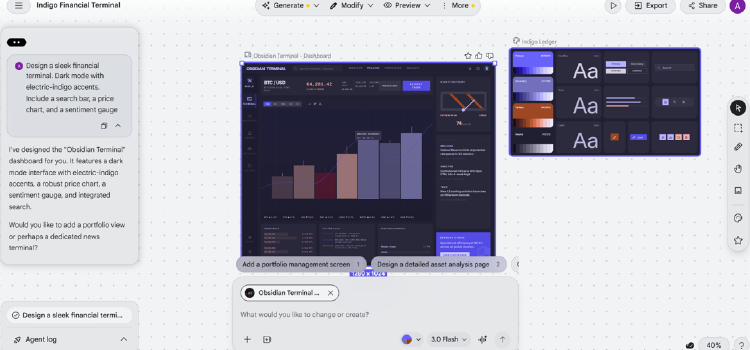
Stitch is an AI-native design canvas where you perform what Google calls 'vibe designing', describing the feeling of an interface in natural language and receiving a high-fidelity prototype in return. For a financial dashboard, a prompt like 'Design a sleek financial terminal. Dark mode with electric-indigo accents. Include a search bar, a price chart, and a sentiment gauge' produces a full design system: color hex codes, typography rules, and component layouts.
A disciplined workflow then extracts a DESIGN.md file from Stitch's output, a structured specification that the agent can reference to enforce visual consistency throughout the build. Stitch is not a design replacement; it is a design accelerant that collapses the distance between intent and a credible starting point.
A2UI: The Declarative Interface Protocol
A2UI addresses a critical challenge in agent-generated interfaces: security and governance. Standard AI agents that produce arbitrary imperative UI code create interfaces that are difficult to audit and govern. A2UI reframes this relationship with a declarative JSON protocol:
A disciplined workflow then extracts a DESIGN.md file from Stitch's output, a structured specification that the agent can reference to enforce visual consistency throughout the build. Stitch is not a design replacement; it is a design accelerant that collapses the distance between intent and a credible starting point.
- Declarative, not imperative : The agent does not send code (which is dangerous). It sends a JSON blueprint: { "type": "Gauge", "value": 85 }.
- Native rendering : Your application receives the JSON and renders the UI using its own trusted, pre-approved components like React, Flutter, or any framework.
- Governance preserved : Engineering teams maintain full control of component libraries while benefiting from agent-generated interface logic.
Case Study: Building AlphaPulse
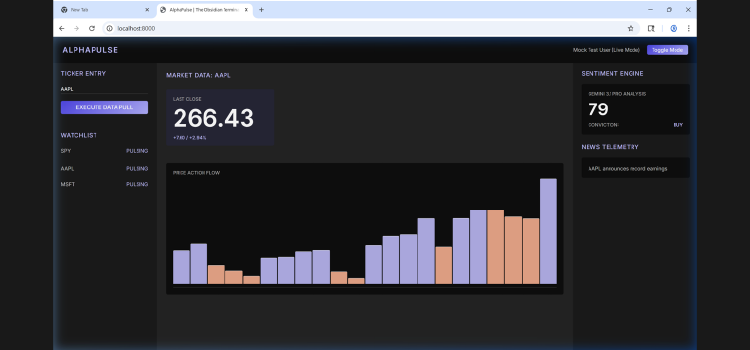
Abstract platform descriptions only go so far. The most useful way to understand Antigravity is through a concrete build. AlphaPulse, a production-ready market intelligence dashboard tracking S&P 500 tickers via Yahoo Finance with news sentiment via Finnhub, makes the workflow real because it forces every dimension of the platform to engage: external APIs, environment variable handling, UI composition, mock-mode fallbacks, implementation planning, browser validation, and developer approval.
Phase 1: Intent and Design (Stitch)
Begin in Stitch with a design prompt establishing the interface language: terminal aesthetic, dark mode, electric-indigo accents, price chart, sentiment gauge. Export the DESIGN.md and place it in the project root, or attach a UI reference image directly to the Antigravity agent to have it generate the design specification.
Phase 2: Building the Memory Bank
Create the four core truth files. The projectbrief.md sets the MoSCoW priorities: Must-have is the Yahoo Finance price feed; Should-have is the Finnhub sentiment gauge. The systemPatterns.md commits to FastAPI for the backend and A2UI for widget rendering. The agent will never drift from these decisions.
Phase 3: Mission Control Execution
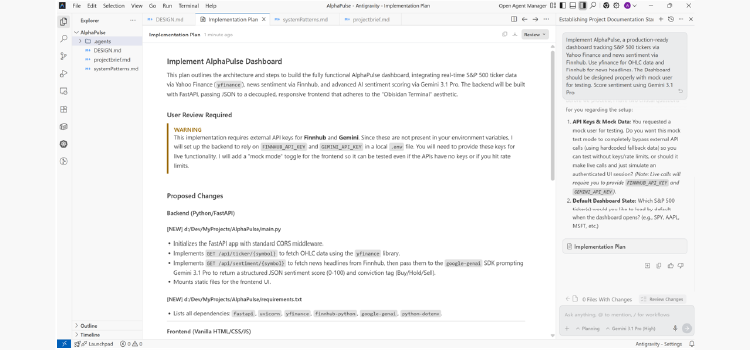
In the Agent Manager, issue the directive: 'Implement AlphaPulse, a production-ready dashboard tracking S&P 500 tickers via Yahoo Finance and news sentiment via Finnhub. Use yfinance for OHLC data and Finnhub for news headlines. Score sentiment using Gemini 3.1 Pro. Design for a Mock Test User.' The agent produces an implementation plan, editable, reviewable, and requiring explicit developer approval before a single file is written.
Phase 4: Walkthrough and Verification
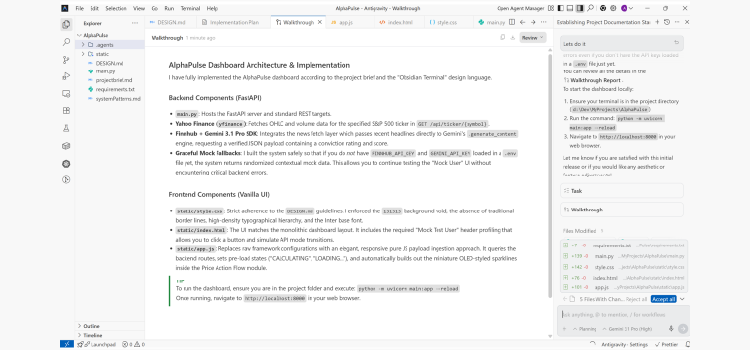
After implementation, the agent produces a structured Walkthrough artifact explaining the architecture, startup path, backend components, frontend components, and the reasoning behind key design decisions. This is a dramatically better handoff than 'here is the code; good luck.' Files modified, line counts, and explicit review/reject controls are visible at a glance.
Phase 5: Browser Validation and Deployment
The agent autonomously opens the application in an integrated Chrome instance, exercises the UI, and produces a webp interaction recording for developer review. Once approved, the Cloud Run MCP server enables direct deployment to Google Cloud, the entire path from intent to deployed software completed within one operating context.
Security and the Environment Sandbox
Because Antigravity agents can execute terminal commands, including destructive ones, the platform operates within a configurable Sandbox. Engineers can set the Terminal Execution Policy to one of three modes:
- Always Proceed : Always proceed: auto-execute all commands except a configurable deny list.
- Request Review : the agent must ask before running any terminal command, the recommended posture for production projects.
- Agent decides : the agent determines when confirmation is needed based on command risk assessment.
For projects involving gcloud deploy, database migrations, or secrets management, the 'Request Review' policy is not optional, it is the minimum governance standard for responsible agentic deployment.
What Still Requires Human Judgment
Antigravity does not eliminate the need for engineering judgment. It changes where that judgment is applied.
Architecture review, permission boundaries, and secrets handling remain human responsibilities. Testing judgment, especially when external APIs or model outputs are involved, cannot be fully delegated. The decision of when a team convention should become a formal workflow rule requires human architectural thinking.
In practice, the most effective agentic teams are not the teams that delegate everything. They are the teams that are disciplined about where they still insist on explicit human approval. Implementation plans, walkthroughs, and browser validation matter precisely because they create clear checkpoints where human judgment re-enters the loop.
The most credible agentic teams are not those who delegate the most — they are those who are clearest about what they will never delegate.
The Real Opportunity
The real opportunity of Antigravity is not that it can generate code quickly. Many tools can do that.
The opportunity is that it makes more of the software lifecycle operable from a single context: intent, planning, execution, review, and verification. That is a meaningful shift for architects, technical leads, and product-minded engineers. It moves software development toward a model where the scarce resource is no longer typing speed. The scarce resource is decision quality.
When paired with strong project conventions, design intent from Stitch, and structured UI patterns through A2UI, the distance between an idea and a working, verified, deployable product collapses in ways that were not previously achievable. The developer who masters this model does not disappear, they become more valuable, operating at higher leverage with each cycle.
Take Away
Google Antigravity makes autonomous task execution governable in practice. The platform represents a genuine architectural shift in how software teams can operate.
The signal is not 'AI replaces engineers.' The signal is that the engineer's role is being elevated: from line-by-line implementation to intent definition, plan approval, quality governance, and architectural oversight. The teams that recognize this shift early, that invest in the conventions, skills, and review discipline that make agentic development reliable, are the teams that will compound their velocity advantage over the next several years.
That is the real Agentic Shift. Not the disappearance of the engineer. The elevation of the engineer into a higher-control, higher-leverage role built on robust & intentional foundations.
FAQs
1. What is the Agentic Shift in software engineering?
The Agentic Shift is the move from AI-assisted coding to autonomous, task-oriented software engineering. Instead of generating code line by line, agentic systems can plan, execute, validate, and document workflows, while developers focus on architecture, governance, and decision-making.
2. How is Google Antigravity different from AI coding assistants?
Google Antigravity goes beyond code completion by using autonomous agents to manage engineering tasks. It combines agent orchestration, artifact generation, browser validation, reusable skills, and persistent project memory, making it more of an engineering operating model than a coding assistant.
3. Can autonomous software engineering replace developers?
No. Autonomous software engineering augments developers rather than replacing them. Human engineers remain responsible for architecture, security, approval checkpoints, testing judgment, and governance, while agents handle more of the execution and verification work.
4. What are the benefits of agentic platforms for enterprise engineering teams?
Agentic platforms can improve developer productivity, automate validation, reduce workflow fragmentation, and strengthen governance through artifacts, rules, and controlled execution. For enterprises, they help teams deliver software faster while maintaining oversight and architectural control.
Resources & Further Reading
Antigravity Platform : antigravity.google
Google Stitch : stitch.withgoogle.com
A2UI Specification : github.com/google/A2UI
Antigravity Codelabs : codelabs.developers.google.com
Google Developers Blog: : developers.googleblog.com