How Would AI Simplify ERP Processes?
Table of Contents:
Introduction
Enterprise Resource Planning (ERP) systems have long been the backbone of enterprise efficiency. Their original promise was clear: streamline processes, integrate data, and improve control. But today’s enterprises are looking for something more. Efficiency alone is not enough. Organizations want ERP systems that are intelligent, adaptive, and predictive, able to not only record transactions but also guide strategic decisions.
Enterprise AI strategies increasingly rely on context-aware intelligence, where ERP systems combine transactional data with business context to deliver more accurate recommendations and support faster, data-driven decisions.
Artificial Intelligence (AI) is the game-changer in this evolution. By embedding AI models, predictive analytics, and intelligent automation into ERP, the platform can transform from a passive system of record into a cognitive enterprise engine. With AI, ERP can forecast demand, optimize cash flow, detect anomalies, and even recommend next-best actions.
This blog explores the challenges with traditional ERP adoption, how AI addresses those hurdles, and how Mphasis brings an AI-first ERP transformation approach that ensures adaptability, speed, and business value.
Challenges
1. Complexity and underutilization for intelligence
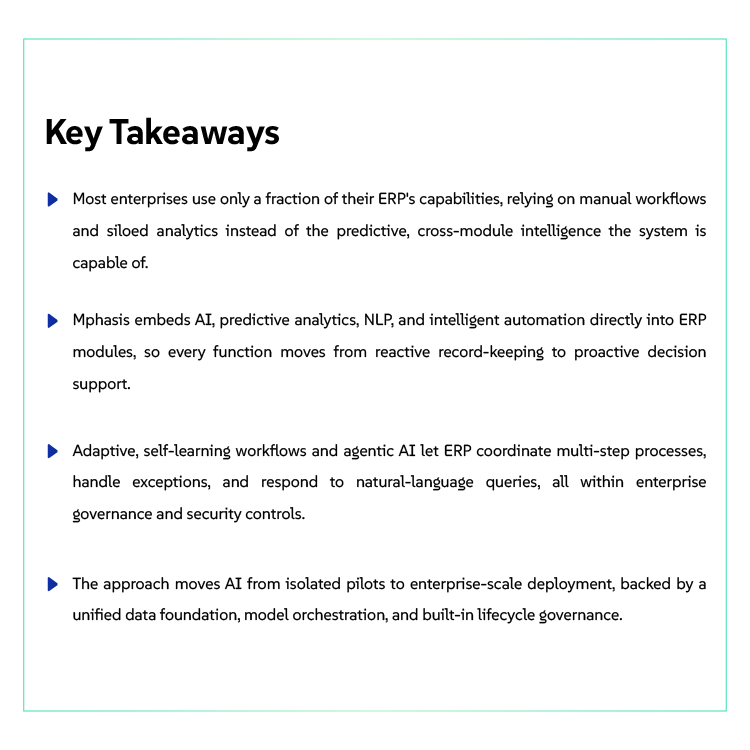
ERP systems like Microsoft Dynamics 365 are vast. They include modules for finance, HR, supply chain, procurement, manufacturing, and more. Yet, most organizations use only a fraction of these capabilities. Instead of harnessing ERP for predictive decision-making, it’s often limited to transactional recording and reporting. The result is underutilization of the system’s full potential, leaving decision-makers reliant on manual spreadsheets or siloed analytics.
2. Manual dependencies slow operations and increase risk
From procurement approvals to invoice matching, many ERP-driven workflows still depend on human intervention. These manual steps not only slow operations but also introduce bottlenecks, compliance risks, and a higher probability of errors. This dependency undermines the very efficiency that ERP was supposed to deliver.
3. Traditional ERP struggles with dynamic scalability
ERP implementations are often long and rigid. Once deployed, adapting them to new business models, market shifts, or compliance requirements can be time-consuming and costly. Enterprises end up with systems that are functionally rich but operationally brittle. In fast-changing markets, this rigidity is a serious drawback.
Mphasis Approach: AI-Enabled ERP Transformation
At Mphasis, the vision is to transform ERP from a static “system of record” into an intelligent, adaptive core that learns, predicts, and autonomously optimizes business operations. Drawing on deep expertise in AI and ERP ecosystems, our strategy centers on embedding AI technologies, machine learning, natural language processing (NLP), predictive analytics, and intelligent automation, directly into ERP modules to elevate every function.
Here’s how the Mphasis approach unfolds:
1. Embedding AI across ERP modules
Mphasis doesn’t treat AI as a bolt-on; instead, it is woven into the very fabric of the ERP system. This enables:
- Predictive analytics integrated into finance, supply chain, procurement, and inventory modules, so the ERP can forecast demand, cash flows, or risk exposure in real time.
- Conversational AI and NLP interfaces, allowing business users to interact with ERP naturally through actions such as asking questions, triggering actions, or pulling reports, all with simple commands.
- Intelligent automation, where repetitive or rules-based tasks such as data validation, reconciliations, and approvals are executed autonomously within ERP workflows.
- Generative AI recommendations, surfacing next-best actions, generating reports, or suggesting strategic options directly within the system.
By embedding these capabilities at the module level, Mphasis ensures that every ERP domain, procurement, finance, HR, and beyond, transitions from reactive to proactive.
2. Intelligent process automation and adaptive workflows
With Mphasis, automation goes far beyond static scripts. Here’s how AI brings adaptability and decision-awareness to ERP processes:
- Autonomous task orchestration coordinates multi-step operations like procurement-to-payment or order-to-cash with intelligence.
- AI-driven exception handling detects anomalies, applies corrective actions, or escalates issues proactively.
- Self-learning workflows evolve over time, refining approval thresholds, routing rules, and process variations based on outcomes and feedback.
This makes ERP workflows leaner, faster, and more resilient to change.
3. Unified data foundation and model orchestration
Mphasis positions ERP as the central nervous system for enterprise intelligence.
- ERP becomes the single source of truth, ensuring clean, trusted data for all AI models.
- Predictive and generative AI models are orchestrated close to ERP so their outputs, including forecasts, alerts and insights, flow seamlessly into dashboards and transaction flows.
- Cross-functional intelligence agents are embedded to act across ERP modules holistically, so users get insights in the flow of work.
This orchestration ensures that AI doesn’t sit on the periphery but drives day-to-day operations.
Enterprises are complementing this foundation with semantic knowledge models and contextual data relationships, enabling AI systems to generate more accurate, explainable, and business-aware recommendations across ERP workflows.
4. From pilots to enterprise-scale integration
Mphasis emphasizes moving beyond experimentation to enterprise-grade AI deployment.
- Pilot use cases, such as fraud detection in procurement or invoice matching in finance, deliver quick wins and measurable outcomes.
- Successful models are then industrialized and scaled across ERP functions, ensuring broader impact without rework.
- AI governance and lifecycle management are built into ERP, ensuring compliance, transparency, and ongoing optimization.
This approach maximizes both business impact and long-term sustainability.
Successful enterprise AI adoption also depends on responsible AI practices, including model governance, explainability, continuous monitoring, and human oversight for high-impact business decisions.
5. Conversational and agentic ERP experiences
Mphasis also envisions ERP powered by agentic and conversational AI, digital assistants that reason, act, and interact:
- Enterprise agents can execute cross-module tasks, such as forecasting cash flow or flagging supplier anomalies, triggered by natural queries.
- These agents orchestrate specialized sub-agents for fields such as finance, procurement and reporting behind the scenes, while presenting a unified experience to the user.
- Because they operate within ERP, these agents understand real-time data, permissions, and workflows, ensuring accuracy and security.
This radically simplifies user interaction, replacing forms and menus with intuitive, conversational engagement.
6. Outcomes of the Mphasis approach
When AI is integrated through the Mphasis lens, enterprises unlock:
- Reduced errors and risk through anomaly detection and automation.
- Higher operational throughput as repetitive tasks are offloaded to intelligent systems.
- Predictive foresight across demand, finance, and compliance functions.
- Adaptive resilience, with workflows that evolve in step with business change.
- Improved user experience, powered by conversational interfaces and embedded analytics.
Summary
How does AI improve ERP performance?
AI automates repetitive processes, delivers predictive insights, and minimizes human error. This enables enterprises to act faster and with greater accuracy across procurement, finance, supply chain, and compliance.
Why choose Mphasis for AI-enabled ERP transformation?
Mphasis integrates AI directly into ERP ecosystems with a focus on design thinking, adaptive workflows, and enterprise-wide scalability. By embedding predictive analytics, automation, and conversational interfaces, Mphasis helps organizations unlock the full potential of ERP as a strategic intelligence engine rather than just a transactional system.
How does Agentic AI improve ERP systems?
Agentic AI enables intelligent software agents to autonomously coordinate routine business processes, recommend next-best actions, and collaborate across ERP functions while operating within enterprise governance and security policies.
Conclusion
ERP systems remain the central nervous system of enterprise operations. But in a world of constant change, they must evolve beyond transaction processing to become engines of intelligence and foresight. AI is the key enabler of that shift, simplifying ERP workflows, automating the mundane, and guiding proactive decision-making.
With ERP (For example, Microsoft Dynamics 365) platform and Mphasis’s innovation-led, AI-first approach, enterprises can elevate ERP from an efficiency tool to a next-generation cognitive core. The result is not just faster operations, but smarter, more adaptive, and strategically aligned processes that help organizations thrive in a dynamic business environment.