Modernizing Legacy Healthcare IT with Mphasis NeoZeta™ powered by Google Gemini Enterprise
Table of Contents:
Healthcare organizations run mission-critical operations on legacy platforms—claims adjudication, member enrolment, utilization management, revenue cycle, and even clinical integrations. Over time, these systems accumulate hidden business rules, brittle interfaces, and outdated documentation, making modernization risky and slow.
Mphasis NeoZeta™, natively powered by Gemini Enterprise, uniquely approaches modernization as a relearning problem: wherein we first extract and validate the real operational logic embedded in code and artifacts, then use that understanding to plan and execute a safe, standards-aligned transformation that preserves patient safety, compliance, and business continuity.
Mphasis NeoZeta™ for Healthcare, powered by Google Gemini Enterprise, helps teams modernize complex legacy estates (payer and provider) by orchestrating discovery, reverse engineering, and modernization workflows across the full SDLC—while keeping regulatory, privacy, and operational constraints front and center.
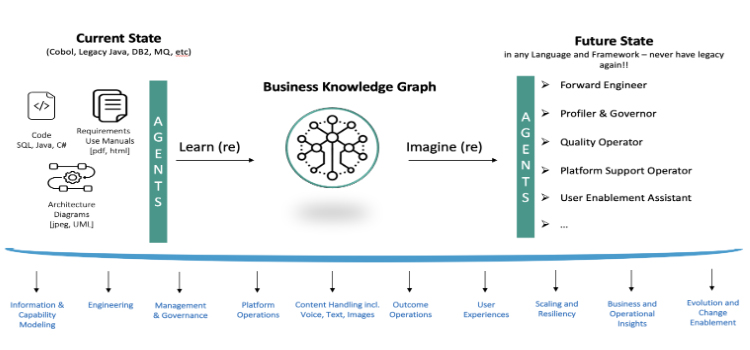
Mphasis modernization approach fundamentally redefines application modernization by turning it into an automated, end-to-end AI pipeline for learning the true behaviour of an existing application stack. Mphasis NeoZeta™ , natively powered by Gemini Enterprise, is designed as a multi-persona IDE extension and web-enabled, it acts as a “Relearn Agent” to extract deeply buried healthcare business rules and domain logic from legacy code and artifacts—such as benefit designs, claims edits, authorization criteria, billing rules, provider contracting logic, and interface behaviours across HL7/FHIR integrations.
Accelerate Relearning with Mphasis NeoZeta™ powered by Google Gemini Enterprise
Mphasis NeoZeta™ platform, natively powered by Gemini enterprise, removes the modernization “black box” by automating the most painful phase of migration: discovery. By ingesting legacy codebases and outdated documentation, Out solution leverages Gemini and graph/knowledge technologies to relearn hidden rules and architecture patterns that drive healthcare operations—so modernization teams can validate behaviour, reduce regression risk, and avoid disrupting patient care or payment accuracy.
The output artifacts include a healthcare domain/subdomain/capability map that connects the legacy application’s behaviour to real-world workflows (clinical, administrative, and financial).
In addition, Mphasis NeoZeta™, powered by Gemini generates:
- Application structure graph / AST of the existing system (using appropriate legacy-language parsers and reasoning) to accelerate impact analysis for regulated healthcare changes.
- Relevant artifacts (interfaces, batch jobs, data mappings, rules catalogs) tied to healthcare standards such as HL7 v2 and FHIR where applicable.
- Refactoring recommendations that prioritize safety, auditability, performance, and maintainability for high-volume healthcare workloads (e.g., claims runs, eligibility checks, prior auth queues).
- Migration and modernization approach with phases/timeline that can feed downstream delivery pipelines (target-state architecture, agile artifacts, test strategy), including governance checkpoints for privacy, security, and regulatory compliance.
- Optionally, the legacy app can be converted to an intermediate representation to support forward engineering into the desired cloud-native stack—while preserving clinical/claims semantics and enabling stronger automated testing and traceability.
At the core of, Mphasis NeoZeta™ fueled by an ontology-driven knowledge graph, accelerates modernization and delivering domain-specific, workflow-centric outcomes for heavily regulated healthcare environments—such as payer claims platforms, provider revenue cycle systems, and clinical integration layers—where privacy, auditability, and uptime are non-negotiable.
Unlike traditional modernization approaches that focus on “lift-and-shift” or rigid code translation (often preserving inefficiencies and hidden risks), Mphasis NeoZeta™ takes a hybrid, safety-first approach. By combining deterministic parsers/reasoners with the cognitive power of generative AI, it doesn’t just translate code—it relearns it, producing explainable knowledge you can validate with SMEs before changing systems that affect patient care, claims accuracy, and regulatory reporting.
The result? You aren’t just migrating to Java, Python, or .NET—you’re extracting durable healthcare business value from legacy systems, mapping it to a healthcare domain ontology, and rebuilding it on open standards so it’s ready for future architectures and interoperability needs. This creates a clearer path to modernization outcomes like faster change cycles, safer releases, improved integration reliability, and stronger audit readiness.
Mphasis NeoZeta™ in action with Multi-Agent Autonomous Workflow:
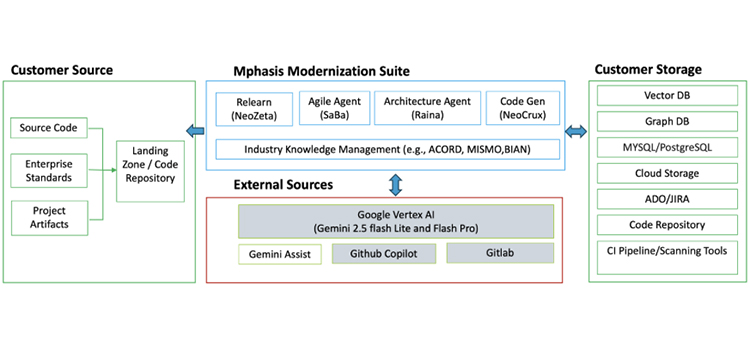
The end to end, Neo architecture orchestrates intelligent codebase relearning, agile planning, target-architecture design, and automated code generation—while maintaining data sovereignty and strong controls for sensitive healthcare data (including protected health information) and aligning outcomes to industry standards and audit needs.
Core Capabilities & End to End Workflow:
- AI-Driven Modernization: Mphasis NeoZeta™ powered by Gemini, extracts and structures the knowledge from legacy landing zones (code, batch, interfaces, documents), interact with agile tools, and perform codebase relearning. Mphasis Raina™ agent, then supports discovery and target-state architecture decisions (including integration patterns for EHRs and payer ecosystems). Mphasis NeoCrux™ then generates detailed specifications and technical tasks grounded in target architecture and domain ontology, enabling coding agents to produce modernized services with stronger automated testing, traceability, and regression safeguards.
- Healthcare & Regulatory Alignment: To maintain continuity and reduce compliance risk, relearned knowledge can be mapped to healthcare interoperability and data standards (e.g., HL7 v2 and FHIR) and governed against privacy/security obligations (e.g., HIPAA) and organizational policies.
- Seamless Integration: The suite interacts directly with customer sources and agile environments, seamlessly pushing all generated artifacts, process data, and modernized code back into the client's ecosystem.
Conclusion
Mphasis delivers a practical, healthcare-ready path to modernization by starting with what matters most: relearning and validating the real operational logic embedded in legacy systems before making change. By combining deterministic engineering with Gemini-powered AI and an ontology-driven knowledge graph, Mphasis NeoZeta™ powered by Google Gemini and other services accelerates discovery, de-risks transformation, and creates traceable, testable modernization blueprints. This enables faster delivery of cloud-native services while preserving clinical and claims semantics, strengthening interoperability through HL7/FHIR alignment, and improving release safety. With compliance-by-design controls for PHI and auditability, healthcare organizations can modernize with confidence—without disrupting patient care or payment accuracy.
This Blog is Written by:
Aijaz Ahmed - CTO, Mphasis Healthcare
Nalla Pitchandy - AI-Architect, Mphasis.ai
Abhishek Agarwal - SVP - Healthcare & Life Sciences