Table of Contents:
A member's eligibility information isn't updated in time. A claim gets held up, the claims team investigates, and the provider follows up on payment. What should have been a routine transaction now involves several people and additional work.
For healthcare payers and third-party administrators (TPAs), situations like this can quietly drive-up administrative costs, situations like this can quietly drive-up administrative costs.
The problem isn't always outdated technology. Often, it's the difficulty of getting enrollment, benefits, claims, and customer service systems to work together. Reducing costs starts with understanding where these connections break down.
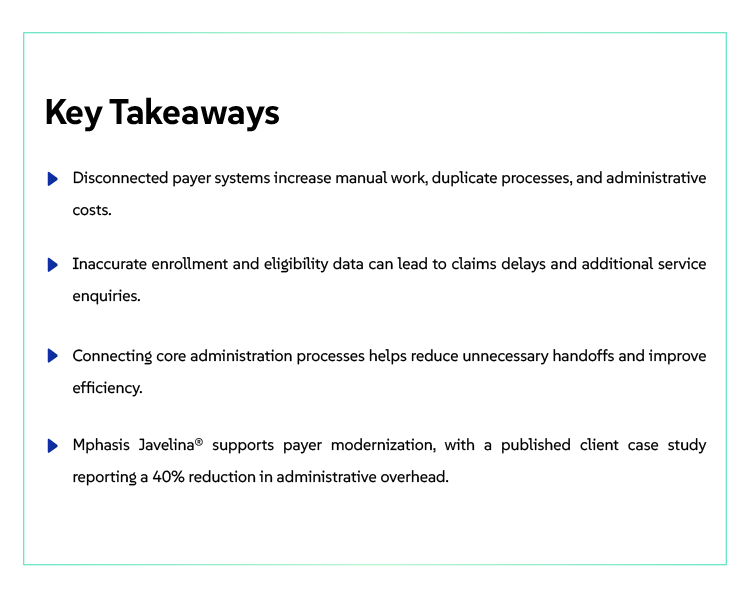
Key Takeaways
Where Are Healthcare Payers Losing Time and Money?
Administrative inefficiencies rarely appear as major system failures. They tend to build up through repeated tasks, data inconsistencies, and manual intervention.
Disconnected Systems Create Unnecessary Work
When information is maintained across different platforms, employees may need to enter the same details multiple times or reconcile conflicting records.
A benefit update, for example, should be reflected wherever that information is needed. When this doesn't happen, teams spend time correcting discrepancies instead of completing their regular work.
Claims Processing Becomes More Complicated
Claims adjudication depends on accurate eligibility, benefits, and provider information.
Missing or inconsistent records can send otherwise straightforward claims into manual review, increasing processing time and administrative effort.
Operational Problems Spread Across Departments
An enrollment issue may eventually become a claims exception or a customer service enquiry.
Each department sees its own workload, but the underlying problem may remain unresolved. Without visibility across operations, payers can end up addressing the same issue repeatedly.
Why Automation Alone Isn't Enough
Automation can reduce repetitive work, but it cannot always correct weaknesses in the underlying process.
An automated claims workflow, for instance, may still require manual intervention if the eligibility information it receives is inaccurate.
Before introducing more automation, payers need to examine why exceptions occur, whether information is consistent, and which handoffs can be eliminated.
The goal is to reduce avoidable work while allowing experienced teams to focus on cases requiring their expertise.
What Does a More Connected Payer Operation Look Like?
A connected administration environment doesn't necessarily mean replacing every application.
It means ensuring that information moves reliably between the systems responsible for enrollment, eligibility, benefits, claims, and member services.
Consistent benefit configuration can reduce duplicated effort when plans change. Accurate eligibility records can prevent unnecessary claims exceptions. Shared access to relevant information can help service representatives resolve enquiries without switching between multiple applications.
Together, these improvements make everyday administration easier to manage.
Modernization Shouldn't Create More Problems Than It Solves
Replacing legacy payer systems is rarely straightforward. Claims still need processing, members need support, and providers depend on accurate information throughout the transition.
A phased modernization approach can help limit disruption.
Payers can begin by identifying processes that generate the most manual work, assessing system dependencies, and prioritizing changes with clear operational value.
Involving claims, enrollment, and service teams is equally important. Their experience often reveals inefficiencies that technology assessments alone may miss.
Mphasis in Action: Reducing Administrative Overhead by 40%
A leading healthcare technology provider was managing different lines of business through three legacy claims platforms: GIS, HEALTHpac, and QicLink.
Disconnected operations had created duplicated processes, manual claims handling, limited reporting, and fragmented customer service.
Mphasis helped consolidate these operations onto the Mphasis Javelina® platform, bringing together claims administration, enrollment, billing, reporting, and customer service capabilities.
The migration was implemented in phases to support business continuity.
According to the published Mphasis case study, the organization achieved:
- 40% reduction in administrative overhead
- 35% improvement in auto-adjudication rates
- Consolidated claims operations and improved reporting visibility
The results demonstrate how simplifying administration and reducing duplicated processes can deliver measurable operational improvements.
Source: Mphasis - Unified Health Platform Cuts Administrative Costs by 40%. Results are specific to this client engagement.
How Mphasis Javelina® Helps Address Payer Administration Challenges
Mphasis Javelina® supports health plans and TPAs across core administration, including plan configuration, enrollment, eligibility, and claims management.
Its modular, API-first architecture helps connect payer processes, while Mphasis combines platform capabilities with healthcare operations expertise.
This aligns with the company's Outcomes as a Service approach, focused on improving operational efficiency and delivering measurable business value.
How Can Payers Tell Whether Modernization Is Working?
A completed migration doesn't automatically mean operations have improved.
Payers should assess whether administrative costs, manual exceptions, and claims turnaround times are decreasing while processing accuracy and service quality are maintained.
Measures such as cost per claim, auto-adjudication rates, and enrollment rework can help identify whether modernization is delivering meaningful improvements.
A Better Way to Think About Administrative Cost Reduction
Administrative costs are shaped not only by technology and staffing, but also by the effort spent correcting information, investigating exceptions, and coordinating between teams.
For healthcare payers, sustainable improvement begins with identifying work that shouldn't be necessary and addressing the processes behind it.
Connected systems and intelligent automation can help, but their real value lies in making everyday administration more reliable and efficient.
Frequently Asked Questions
What are the main causes of high healthcare payer administrative costs?
Common causes include disconnected legacy systems, duplicate data entry, inconsistent enrollment and eligibility records, manual claims reviews, and repeated coordination between departments. These activities increase the time and resources required to complete routine transactions.
How can health plans reduce administrative costs without affecting service quality?
Health plans can start by identifying recurring manual work, improving data accuracy, simplifying processes, and connecting systems that depend on the same information. Improvements should be measured against processing efficiency, accuracy, and member and provider service outcomes.
How does payer core administration modernization improve claims processing?
Modernized core administration can help claims systems access more consistent eligibility, benefit, and provider information. This can reduce avoidable exceptions and support higher levels of automatic adjudication, provided that business rules, data quality, and integrations are properly managed.
Does payer modernization require replacing every legacy system?
Not necessarily. Organizations can take a phased approach, prioritizing the systems and processes responsible for the greatest operational inefficiencies. The right strategy depends on existing infrastructure, integration requirements, business continuity needs, and long-term objectives.
Conclusion
Reducing payer administrative costs is less about adding more technology and more about removing work that shouldn’t exist. When enrollment, eligibility, benefits and claims share reliable information, fewer claims become exceptions, fewer members and providers need to call, and teams spend less time bridging system gaps.
For health plans and TPAs, the practical starting point is to find where avoidable work originates, fix the process behind it, and modernize in phases that protect day-to-day operations. If you’re exploring this path, the Mphasis team will be at HLTH USA 2026 (November 15–18) to discuss how Mphasis Javelina® can support more connected, efficient payer administration.
Connect with Mphasis at HLTH USA 2026
Meet Mphasis at HLTH USA 2026, November 15–18, to explore how Javelina® supports connected payer administration and operational efficiency.
Explore Mphasis Healthcare Solutions