Table of Contents:
Getting a prescription is one part of a patient's journey to treatment. The steps that follow can involve benefits verification, prior authorization, affordability support and coordination with a specialty pharmacy. Each activity may involve a different team, system or organization.
For pharmaceutical manufacturers and patient hub providers, keeping that work connected is a challenge. Information needs to move between healthcare providers, payers, hub teams and pharmacies, with a clear understanding of what has been completed and what needs to happen next.
When those handoffs break down, teams can find themselves chasing updates, repeating administrative work or trying to establish why a case has stopped progressing. For patients prescribed specialty therapies, including treatments for rare diseases and cell and gene therapies, these gaps can complicate the path to treatment.
Addressing this challenge requires more than automating individual tasks. Manufacturers need the ability to connect information, make informed decisions and coordinate action across the patient hub ecosystem.
This is where the Enterprise Agency becomes relevant. Through Mphasis Tria™, the focus moves beyond what individual AI agents can do towards how the enterprise can use intelligence, foresight and governed execution to improve patient services.
Intelligent Case Orchestration is one application of this approach. It helps identify stalled cases, recommend next actions and connect those actions with the relevant workflows, while human specialists retain oversight of exceptions.
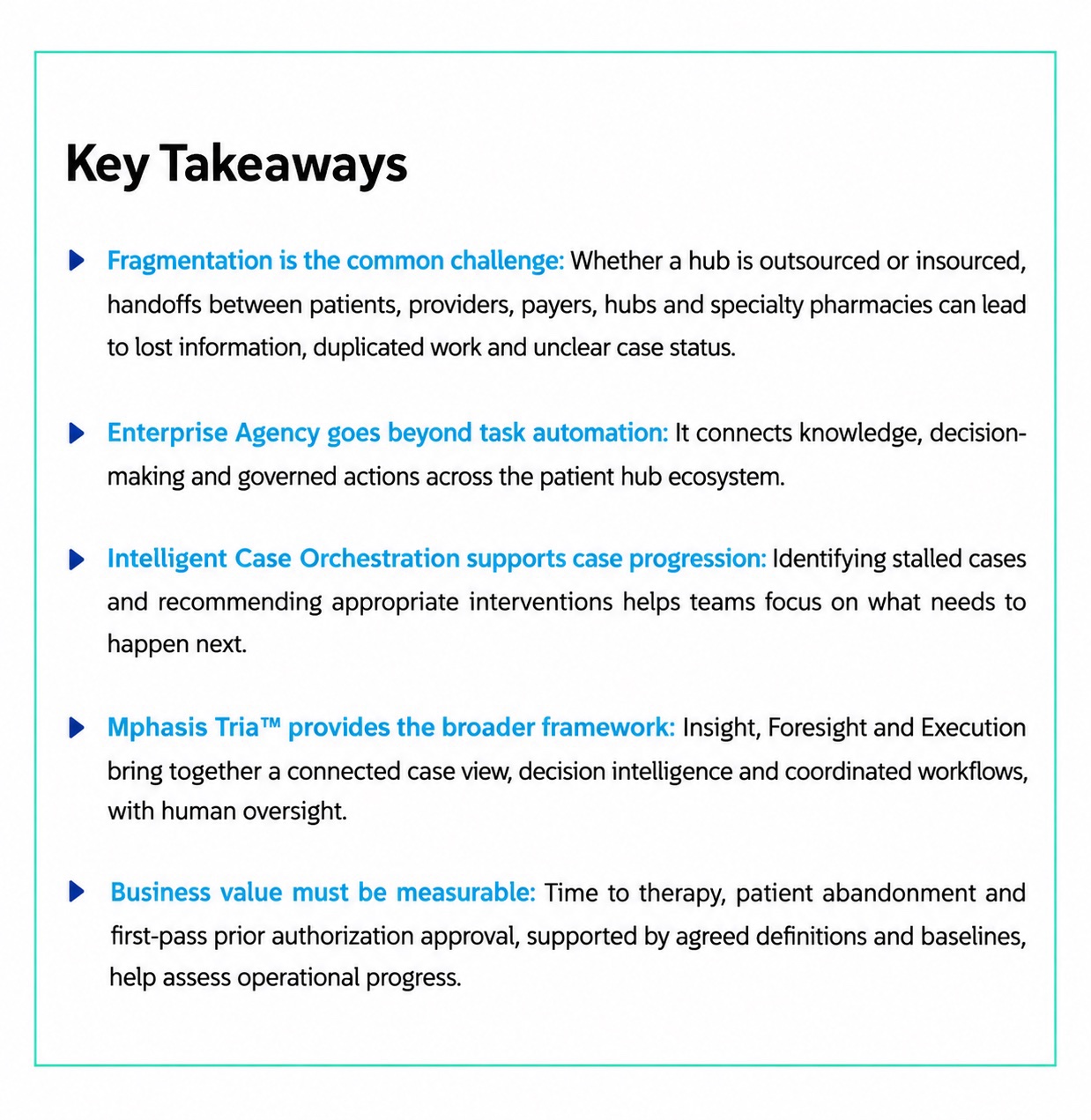
Key Takeaways
Why fragmentation continues to affect patient hub operations
Patient hub services bring together activities that depend on one another. Enrollment information informs benefits investigation. Coverage requirements shape prior authorization work. Affordability support and specialty pharmacy coordination may also be needed before a patient can move forward.
Managing each activity separately can make it difficult to understand the position of the overall case.
Disconnected information makes case status harder to establish
Enrollment records, coverage details, authorization updates and fulfillment information may sit across different systems and organizations.
With outsourced hubs, manufacturers may receive partner data in batches, reducing visibility into current case status. With insourced hubs, manufacturers assume greater responsibility for integrating CRM, contact center, field team and patient services systems.
Both models require a way to bring relevant information together and establish who owns the next action.
Benefits investigation and prior authorization require continued coordination
Coverage verification and prior authorization involve documentation, payer requirements, provider communication and follow-up.
A service-level agreement may show whether an activity was completed within a specified period, but manufacturers also need to understand whether the patient's case is progressing. An unresolved requirement in one workflow can affect the activities that follow.
This makes case visibility and timely intervention important measures of hub performance.
Operational ownership changes across hub models
Outsourcing can give manufacturers access to specialized teams and operational capacity, while placing some control over technology and workflows with the hub provider.
Insourcing offers greater ownership of the patient experience, alongside responsibility for staffing, systems integration, platform maintenance and operational governance.
Neither model removes the need to coordinate the wider ecosystem.
An Enterprise Agency approach can support this coordination by connecting information, decisions and actions across existing systems and stakeholders, without requiring manufacturers to replace their hub operating model.
What Fragmentation Means for Patients and Manufacturers
In practice, a case may pass from the patient to the healthcare provider, the hub, the payer, the specialty pharmacy, field reimbursement teams, copay or patient assistance programs and back to the manufacturer.
Each handoff creates the possibility of lost information, duplicated work and unclear status.
For patients, this can mean a longer wait to start therapy and a greater chance that the case does not reach treatment. For manufacturers and hub teams, it can mean more manual follow-up and less certainty about where a case is stuck.
These challenges highlight why automating individual workflows is not enough.
The broader requirement is to help the enterprise understand what is happening, determine the next appropriate action and coordinate execution across the patient services ecosystem.
The Mphasis Approach: Bringing Enterprise Agency to Patient Hub Services
Mphasis Pharma Patient Hub Services combines business and hub services with technology services and managed operations. The offering covers patient intake, enrollment, access and affordability workflows, supported by platform engineering and ongoing operational support.
Within this approach, Intelligent Case Orchestration addresses a specific need: connecting the information available about a patient case with the decisions and actions required to move it forward.
Mphasis Tria™, the Enterprise Agency Platform, provides the broader foundation for this approach.
The Tria promise extends beyond deploying autonomous AI agents. It focuses on enabling the enterprise to use its knowledge, anticipate operational needs and coordinate governed actions that contribute to measurable outcomes.
In patient hub services, this takes shape through three connected layers: Insight, Foresight and Execution.
Mphasis Ontosphere™ provides the knowledge and context behind Insight. Mphasis Continuum™ supports the decision intelligence behind Foresight. Mphasis AI Platform enables agentic execution and orchestration.
Together, these capabilities connect enterprise intelligence with the work required across patient services.
Insight creates a connected patient case view
The Insight layer brings together forms, claims, benefits investigation information, electronic health records and payer data.
For hub teams, the purpose is to understand the information available across the patient journey and the work that remains outstanding.
A connected case view provides the context needed to coordinate activities across teams and establish which requirements have already been addressed.
Foresight supports decisions about the next action
The Foresight layer describes predictions about coverage, prior authorization approval, copay risk and delays, alongside next-best-action recommendations.
These capabilities are intended to help teams recognize where a case may require attention and consider the appropriate response.
The same case context can support hub agents and case managers through relevant payer requirements, real-time case summaries and recommended actions.
Rather than simply responding to tasks as they arise, the enterprise can work towards identifying operational barriers earlier and directing attention where it is needed.
Human specialists remain involved in decisions and exceptions requiring professional judgment.
Execution connects recommendations with workflows
The Execution layer describes how specialized agents can support activities across benefits investigation, prior authorization, triage and fulfillment.
The wider operating model also includes ingestion, intake, follow-up and financial services agents.
These agents connect information and recommendations with the work required across patient services.
The value of Enterprise Agency lies in bringing these capabilities together: the enterprise has access to relevant information, can assess what needs to happen next and can coordinate the appropriate action through governed workflows.
Agentic AI supports execution within this model, while human experts retain responsibility for exceptions and oversight.
Case Study: Reimagining Patient Services for a Life Sciences Company
Client: A Life Sciences and Pharma Company
The Mphasis case study describes an operating model in which specialized AI agents work alongside human experts across patient services.
Its scope extends from capturing referral information to coordinating affordability support and fulfillment.
The model illustrates how Enterprise Agency can be applied to patient hub operations by connecting case information, workflow responsibilities and human decision-making within a coordinated approach.
Patient intake and case creation
The workflow begins with capturing referral and enrollment forms.
Optical character recognition and document classification support the processing of incoming documents, which are attached to an existing case or used to create a new one.
Intake covers patient demographics, healthcare provider and diagnosis details, insurance and prescription information, and consents or authorizations.
These activities establish the information needed for subsequent access and support workflows.
Benefits investigation and prior authorization
Benefits investigation includes verifying active coverage, conducting electronic and manual investigations, and generating a Summary of Benefits.
The prior authorization workflow covers identifying the need for authorization or pre-determination, notifying the healthcare provider, tracking progress toward approval and managing appeals.
The operating model places these activities within a connected patient services framework, showing the relationship between coverage information, authorization requirements and follow-up.
Follow-up, affordability and fulfillment
Follow-up activities include confirming approval or denial, discussing costs and routing patients to financial assistance.
Financial services cover copay card matching, patient assistance program eligibility and foundation referrals.
Triage and fulfillment extend the workflow to specialty pharmacy coordination, including prescription routing, pharmacy checks, shipment and receipt confirmation, and nurse coordination.
These responsibilities establish the scope of the model without implying that every activity operates autonomously.
Human expertise and agent governance
Human specialists remain part of the operating model. The roles include intake specialists, benefits analysts, prior authorization coordinators, patient navigators, pharmacists and financial counselors.
Clinical teams and technology, compliance and quality leaders also contribute to oversight.
The model identifies supporting responsibilities for DataOps engineers, who prepare and enable data for AI, and AIOps engineers, who train and govern agents.
This combination of specialized AI capabilities and human expertise reflects the broader Enterprise Agency approach: connecting operational intelligence with execution while retaining accountability for decisions and exceptions.
The case study illustrates the operating model and its intended capabilities. It does not provide quantified implementation outcomes.
Measuring the Value of Enterprise Agency in Patient Hub Services
The value of Enterprise Agency should be assessed through the business and patient access outcomes it is intended to support, rather than the number of AI agents deployed or activities automated.
Relevant indicators include:
- Time to therapy: To assess progress through the patient access journey.
- Patient abandonment rate: To understand where cases do not progress to treatment.
- First-pass prior authorization approval: To assess authorization performance.
- Case-manager productivity: To evaluate how operational effort is used.
- Patient contact rate: To assess the effectiveness of outreach.
- Cost per case: To understand the resources required to support cases.
- Service-level adherence: To track performance across internal teams and external partners.
These measures need agreed definitions and baselines.
Consistent measurement helps manufacturers understand where cases stall and assess whether changes to the operating model support progress.
For Mphasis Tria™, this connects to the broader Enterprise Agency proposition: using intelligence and governed execution to support outcomes that can be monitored and evaluated.
These measures provide an evaluation framework and should not be confused with results achieved in a particular implementation.
Frequently asked questions
What is Enterprise Agency in Patient Hub Services?
Enterprise Agency is an approach to connecting enterprise knowledge, decision intelligence and governed execution across patient services. It helps organizations understand case information, identify required actions and coordinate workflows across the existing hub ecosystem.
How does Enterprise Agency differ from Agentic AI?
Agentic AI focuses on what individual AI agents can perform or automate. Enterprise Agency takes a broader view, connecting AI capabilities with enterprise context, decision-making, governance and measurable business outcomes.
How does Intelligent Case Orchestration fit into Enterprise Agency?
Intelligent Case Orchestration is an application of Enterprise Agency in patient hub operations. It connects case information, recommended actions and workflows to help identify stalled cases and coordinate the next appropriate intervention.
Can Enterprise Agency support outsourced and insourced hubs?
Yes. Both models involve coordination across stakeholders and systems. Mphasis's approach is intended to connect activities across the existing ecosystem, with responsibilities shaped by the manufacturer's operating model.
What role does Mphasis Tria™ play?
Mphasis Tria™ provides the Enterprise Agency Platform, connecting knowledge, decision intelligence and governed orchestration. In patient hub services, the Insight, Foresight and Execution layers support the coordination of information, recommendations and workflow activities.
Conclusion: Moving Beyond Automation Towards Enterprise Agency
For manufacturers and patient hub providers, fragmentation becomes visible in the everyday work required to move a case forward: finding information, confirming ownership and following up on unresolved requirements.
These gaps exist whether the hub is outsourced or insourced because patient access depends on coordination across multiple stakeholders.
Automating individual tasks can help reduce administrative effort. But improving the overall patient journey requires a broader approach.
Enterprise Agency brings together the ability to understand what is happening, anticipate where intervention may be needed and coordinate the next action through governed workflows.
With Mphasis Tria™, Insight provides enterprise context, Foresight supports informed decisions and Execution connects those decisions with operational activities. Agentic AI enables parts of this work, while human specialists manage exceptions and apply professional judgment.
The objective is not to replace existing hub providers or introduce automation for its own sake. It is to help the patient services ecosystem work with greater visibility, coordination and accountability.
For manufacturers considering this approach, a practical starting point is to establish baselines for measures such as time to therapy, abandonment and prior authorization performance, and identify where cases are losing momentum today.
Mphasis brings patient hub domain knowledge, technology services and managed operations to this challenge as part of its broader Life Sciences services.
Speak with Mphasis about applying the Enterprise Agency to connect information, decisions and operational workflows across your Pharma Patient Hub Services ecosystem.