Modernizing Legacy Banking & Financial Services IT with Mphasis NeoZeta™, natively powered by Google Gemini Enterprise
Table of Contents:
For all the noise around AI, the conversation still tends to orbit the same objects: bigger models, longer context windows, flashier demos, louder claims.
Why Modernization in BFSI Is Urgent and Difficult
Banking and financial services institutions continue to depend on legacy platforms to run some of their most critical operations - core banking, deposits, lending, cards, payments, finance, settlement, and wealth management. These environments are not just old systems; they embody decades of business rules, processing logic, interface dependencies, batch orchestration, and control mechanisms that are often only partially documented, yet essential to daily operations.
That is what makes modernization in BFSI fundamentally different from modernization in most other industries. The systems that need to change are also the systems that cannot fail.
Financial institutions today face growing pressure from digital-first customers, fintech competition, real-time payment expectations, regulatory change, cloud transformation, and the need to launch products faster. At the same time, they must preserve uptime, meet cut-off and settlement windows, maintain reconciliation accuracy, safeguard customer and transaction data, and satisfy increasingly stringent audit and compliance requirements. With legacy SME availability shrinking and operational risk remaining high, many modernization programs stall between business urgency and execution risk.
Mphasis Unique Approach: Modernization Begins with Relearning
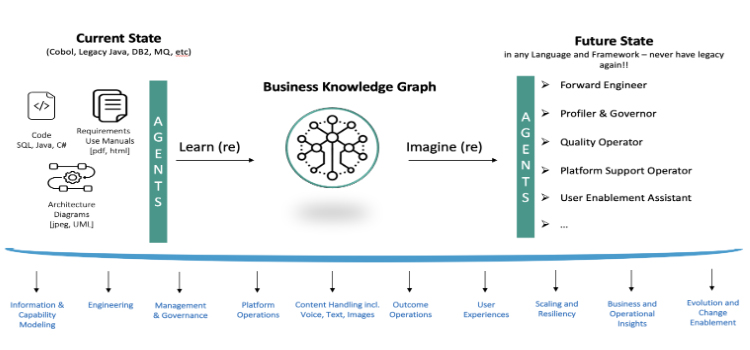
Before an institution can safely transform a legacy system, it must first understand what that system is actually doing - not just what the documentation says it should be doing. In complex BFSI estates, the true behavior of an application is often buried across legacy code, batch jobs, interface logic, data structures, copybooks, operational scripts, and fragmented documentation. Therefore, Mphasis NeoZeta™, natively powered by Gemini, was designed to uncover, organize, and validate that operational reality.
Mphasis built NeoZeta™, natively powered by Google Gemini Enterprise, fundamentally helped address the complex legacy modernization as first a relearning problem, before it can be handed over to autonomous agents for forward engineering.
Rather than approaching modernization as a narrow code conversion exercise, NeoZeta™ applies a controls-first, intelligence-led model that helps institutions extract the embedded business logic of legacy systems and convert that understanding into a safer, more structured modernization roadmap.
From hidden logic to explainable modernization knowledge
NeoZeta™ is designed to assist banks, card processors, payment platforms, capital markets firms, and wealth management organizations accelerate discovery, reverse engineering, and modernization planning across the software delivery lifecycle.
By combining deterministic engineering analysis with Gemini-powered reasoning, NeoZeta™ surfaces deeply buried business and technical logic from legacy environments, including:
- Product configuration and fee schedules
- Interest accrual and amortization logic
- Credit decisioning and servicing rules
- Authorization, dispute, and chargeback flows in card platforms
- Settlement and reconciliation logic
- Ledger posting behaviour and financial controls
- Interface patterns spanning ISO 8583, ISO 20022, ACH, SWIFT, FIX, and proprietary integrations
This is where NeoZeta™, powered by Gemini, is unique and stands apart. It does not simply translate code. It relearns the legacy estate and converts that understanding into explainable artifacts that architects, engineers, and business SMEs can validate before transformation begins.
Removing the Modernization Black Box
One of the most painful stages of legacy modernization is discovery. It is time-consuming, SME-dependent, and often incomplete. NeoZeta™ removes much of this black box by ingesting legacy codebases, batch definitions, interface specifications, data models, and outdated documentation to reconstruct how the system actually works.
This enables modernization teams to:
- Validate current-state behaviour earlier
- Reduce regression risk before code changes are made
- Improve impact analysis for new products, fee changes, payment format migrations, and control updates
- Preserve operational continuity for customer servicing, payment execution, settlement accuracy, and regulatory reporting
- Lower dependency on scarce legacy subject matter experts
The result is a faster, more reliable foundation for modernization.
Structured outputs that accelerate downstream delivery
NeoZeta™, powered by Gemini, produces more than analysis. It generates structured artifacts that can directly support modernization planning and execution, including:
1. Application structure and dependency intelligence
NeoZeta™ produces application structure graphs, call chains, program chains, and dependency views that help teams understand how legacy systems are wired together. This improves impact analysis and allows modernization programs to prioritize the areas of highest business, operational, or regulatory significance.
2. Business and technical rule extraction
The platform can identify and document business rules, technical rules, data relationships, control logic, interface behavior, and batch flows embedded inside the codebase and surrounding artifacts. This helps convert institutional knowledge trapped in legacy systems into reusable modernization intelligence.
3. Domain-aligned capability mapping
NeoZeta™ maps legacy behavior to real-world BFSI workflows such as onboarding and KYC, deposits, lending, payments, cards, treasury, servicing, trading, custody, and wealth operations. Where relevant, those outputs can also be aligned to BIAN service domains to improve standardization and accelerate target-state architecture design.
4. Refactoring and modernization guidance
NeoZeta™ generates recommendations for modernization patterns and sequencing, prioritizing outcomes such as resiliency, auditability, maintainability, throughput, latency, and data integrity for high-volume BFSI workloads.
5. Intermediate representation for forward engineering
Where required, legacy applications can be converted into an intermediate representation that supports forward engineering into modern cloud-native stacks while preserving financial semantics and improving testability, traceability, and control evidence.
Why the ontology-driven knowledge graph matters
At the core of Mphasis modernization approach is an Ontology-driven knowledge graph that helps transform fragmented legacy knowledge into a connected, reusable modernization asset.
In most legacy environments, critical knowledge is scattered across code, documents, batch flows, data structures, interfaces, and tribal memory. NeoZeta™ organizes these into a structured model that links systems, workflows, business rules, controls, data, and dependencies in a way that is queryable, explainable, and reusable across the modernization lifecycle.
For banking and financial services institutions, this is especially powerful. It creates a durable layer of enterprise understanding that can support not just discovery, but also design, testing, compliance validation, impact analysis, and future change programs. It also provides a stronger bridge between legacy behavior and open, standards-aligned target architectures.
Beyond lift-and-shift: a faster & safer modernization path
As we addressed above, NeoZeta™ takes a different path, by combining deterministic parsers and reasoning with generative AI, it provides institutions with explainable modernization knowledge that can be reviewed and validated before systems are changed.
This is particularly important in BFSI environments where defects can lead to authorization failures, fraud exposure, inaccurate postings, settlement breaks, reconciliation issues, or regulatory reporting errors.
The outcome is not simply migration from COBOL or other legacy stacks into Java, Python, or .NET. It is the extraction of durable business value from legacy systems and the rebuilding of that value on a stronger, more transparent, and more adaptable foundation.
Mpahsis NeoZeta™ as part of end-to-end multi-agent modernization workflow- Post Relearning
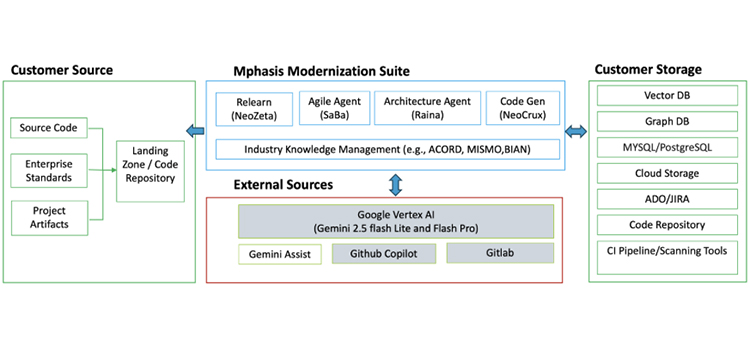
Mphasis is designed NeoZeta™ to operate as part of an end-to-end modernization agentic workflow spanning relearning, planning, architecture, and delivery agents.
It starts by extracting and structuring knowledge from legacy code, batch jobs, documents, interfaces, and data definitions. That relearned intelligence can then support downstream agents and engineering workflows for target-state architecture, agile planning, specification generation, forward engineering, testing, and delivery execution.
This makes NeoZeta™ more than a discovery engine. It becomes a foundational modernization intelligence layer — one that improves decision-making, reduces ambiguity, and increases consistency across the full program lifecycle.
Security, privacy, and compliance by design
In BFSI, modernization must be achieved without compromising security, privacy, or regulatory posture.
We designed, NeoZeta™ to support modernization in environments containing highly sensitive information, including PII, account data, cardholder information, balances, positions, and transaction records. Throughout the relearning and modernization process, institutions can maintain traceability, preserve control evidence, and align outputs to internal governance requirements and external obligations such as PCI DSS, GLBA, SOX, and AML/KYC frameworks.
This is critical because modernization success in financial services is not only about faster delivery - it is also about proving that transformation was executed safely, transparently, and in alignment with control expectations.
Proven Real Impact in a large-scale financial modernization program
NeoZeta™, natively powered by Gemini Enterprise, has already demonstrated measurable results in large-scale financial modernization programs.
In one engagement, for a leading global financial technology provider on a multi-year modernization journey, Mphasis successfully used NeoZeta™ relearning agent, powered by Google Gemini, to relearn a large COBOL-based platform supporting account processing, digital banking, and payments, in 2 months, that would have typically taken 12-18 months.
The program delivered significant results:
- Approximately 1.2 million lines of code relearned
- Around 803 COBOL programs analyzed
- Approximately 1,750 copybooks processed
- Discovery and relearning completed in roughly 2 months, versus an estimated 12–18 months using traditional approaches.
- Static code analysis, call chains, program chains, business and technical rules, data dictionary, knowledge graph, user stories, forward code assets, and unit tests delivered within approximately 3 months.
Thus demonstrating, how Mphasis NeoZeta™, powered by Gemini, can materially compress modernization timelines while reducing program risk and improving transformation readiness.
Driving Faster Outcomes for Financial Institutions
For banks and financial services firms, modernization is no longer optional—and it cannot be reduced to a generic code migration exercise.
Winning programs start with one disciplined move: relearn the legacy estate as it truly runs in production, then convert that knowledge into a structured, traceable, standards-aligned path forward. That is where Mphasis NeoZeta™, natively powered by Google Gemini Enterprise, creates its advantage.
By combining deterministic engineering, Gemini-powered reasoning, and an ontology-driven knowledge graph, NeoZeta™ turns hidden logic into explainable modernization intelligence - accelerating discovery, strengthening audit-ready traceability, and reducing transformation risk from day one.
The result: faster modernization with confidence - preserving financial semantics, control integrity, and operational resilience—so institutions can deliver new products and experiences at digital speed without compromising trust.
This Blog is Written by:
Bharat Kundnani - SVP Platforms and BFS Transformation Principal
Haleem Vaince – VP & Engineering Head of Mphasis.ai Platforms
Sriram Krishnamachari – VP & Global Head Google Business